Comfort, Durability & Quality are Hallmarks of the New Granite
Premium vocational truck lives up to legacy while delivering sought-after features
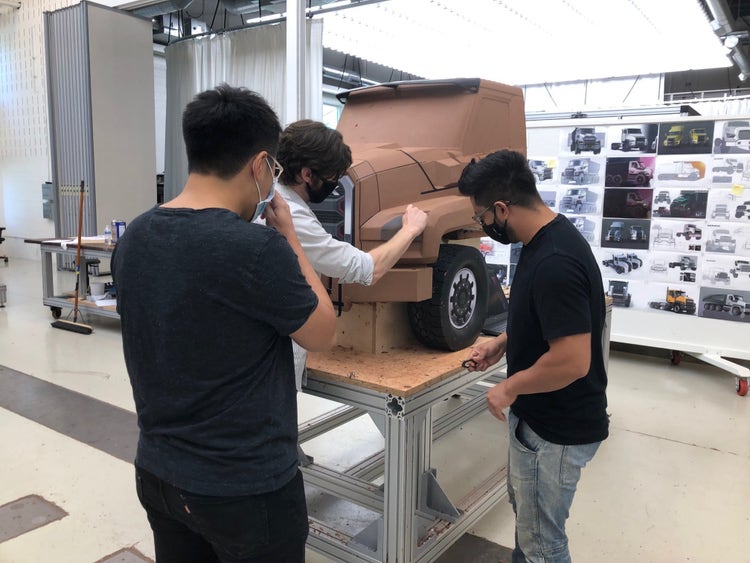
It’s rare that chief vehicle designers get to start the design process with a clean sheet of paper. But that is exactly what Lukas Yates and Vincent Lokers — chief designers, exterior and interior, respectively — had the opportunity to do when designing the all-new Mack® Granite®. The clean sheet approach, also called “body in white,” freed the designers from legacy restrictions and allowed them more latitude in the design of the vehicle.
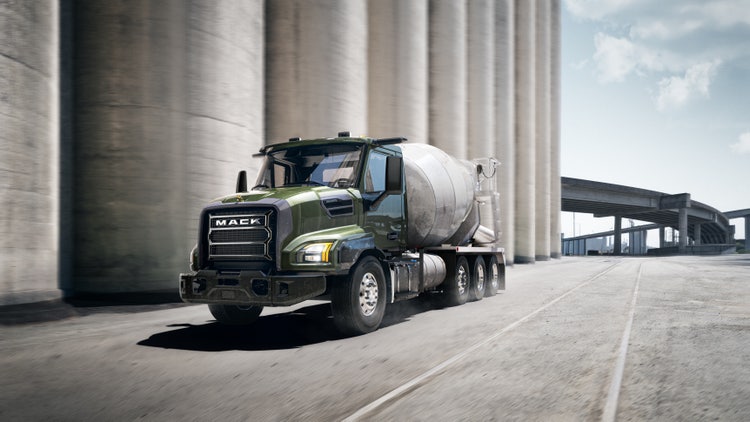
Having that freedom allowed Yates and Lokers to design a truck with driver comfort, durability, and quality in mind. “When you have a blank sheet of paper, you have this responsibility to bring the Mack DNA and feeling to the table,” Lokers says. Yates says designers had to look at chassis components, engine components, the cab, and the hood together to optimize the truck and not compromise on durability or driver comfort.
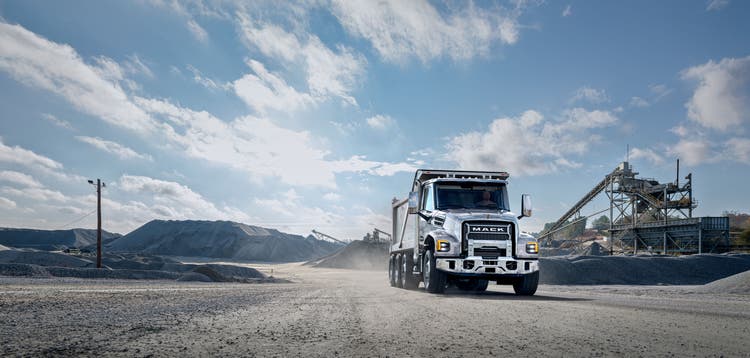
Yates views the Granite as the cornerstone on any construction site. “Over the years the truck has been synonymous with getting the job done, and we had to make sure the new Granite carried on that legacy. Functionality came first with this truck.”
Yates says the designers used the Mack R model for inspiration: “We have a hood feature on the side of the air intake that kicks up at a 45-degree angle.” However, he is quick to point out that the designers were not interested in making a retro truck.
“We tried to find the next best thing to push technology, comfort, and durability, but also push design,” Yates says.
The Driver Experience
Ensuring driver comfort was top of mind for the designers of the new Granite. “Because it was an all-new body in white development, I had the freedom to move things that we never had before, because we didn’t have any legacy components to mate up with,” Lokers explains.
This meant that designing the driving environment around the driver allowed Mack to optimize the visibility, reachability and ergonomics of the designs and HMI positioning. For example, the top of the instrument panel (IP) was pushed forward a bit, and the bottom was pulled rearward, which tremendously improved visibility and ergonomics of the IP design layout, creating a commanding driver-centric position. Lokers said this gave drivers “a comfortable feeling of control and confidence.”
It was challenging integrating metal into key areas drivers interface with frequently, seeing how Mack’s supply chain is highly plastic focused. However, these metal touchpoints, such as the door release handle, produce not only a durable solution over plastic, but confidence and quality that will last, which is something drivers are after.
The instrument panel extrusion serves two main functions. One is as an accessory rail that allows drivers to mount personal devices like cellphones or monitors. Drivers can position those devices to optimize visibility. And two, drivers with bad hips or knees can wrap their fingers around the structural extrusion to help pull themselves up from the seated position. There’s also a cord management section which keeps cords from hanging down on the instrument panel.
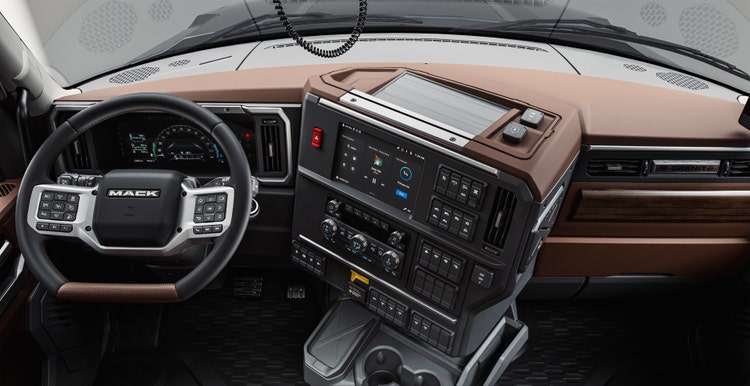
The idea to design the extrusion structurally strong enough for drivers to help themselves up from seat position or move around the cabin came following a clinic where approximately 25 drivers were brought in to evaluate early prototypes of the Granite. Branding was removed from the clay, foam, and 3D-printed designs being reviewed, so drivers did not know they were evaluating a new Mack truck.
The HMI switch layout on the Instrument panel is customizable, meaning drivers can move switches around so more frequently used switches can be prioritized closer to the driver. The secondary information display, which drivers use to display driver information and maps, is now nine inches wide. The switches have laser-etched symbols or text on them, adding to the durability of the design, which Lokers said will add value to these trucks at resale.
“We brought drivers in to rate the ergonomic design layout, the reachability, and the visibility,” Lokers explains. “We did this midway through the design process, so if there were any constructive comments, we had time to redesign.”
The door panel also was set up for the driver comfort, balancing downward visibility and ergonomics, which helped optimize the correct placement of controls and arm comfort to the dash panel. A section behind the door panel channels heating and air conditioning onto the driver’s shoulder. That feature also helps defrost the side glass. The all-new steering wheel retains the Mack flat bottom design and has an air bag in it — a first for Mack.
Designers sought input from a variety of people during the development years, asking about drivers’ pain points. Service technicians said drivers would drill into the side of the instrument panel to mount screens or devices, and this would sometimes cause the plastic to crack. To avoid that, the ELD plate is a branded metal mount that provides a durable, standardized platform for securely attaching various devices through modular accessories.
In previous models, drivers would lean forward to interact with transmission controls and gear selections. In the new Granite, the transmission controls have been moved to the steering column stalk. Drivers who participated in the clinic liked this feature because it allowed them to keep their hands on the steering wheel while shifting gears, which improves safety.
An all-new seat frame was developed for the Granite. A wide seat foam is designed to provide more leg, back, and lumbar support, optimizing comfort for drivers. The bolsters wrap around, and there is more shoulder room. “The seat has more of a race car support design,” Lokers says. There is also an option for heating and cooling, and a massage feature in the new seat. Seat material options include fabric, vinyl, and leather. “We are very proud of our new seats. They provide a lot of driver comfort, and we are getting good reviews from drivers about them,” Lokers says.
Enhancing the Living Area
There are three options for the living area of the truck. The short option has no cabinetry and a flat-back bed. The medium option has cabinets and a reclining bunk in which the upper section is inclined. The long option has more cabinetry, a large wardrobe cabinet, and a Versa bunk. The bunk’s mattress rotates up onto the sleeper’s rear wall, so the bed is not visible when not in use. When the bunk is stowed, a table can be folded down from the rear wall, and seats can rotate up to provide a workspace for drivers. “Drivers have a great deal of space to stand up and get dressed in; they have never had this much space,” Lokers says.
According to Yates, the Granite can accept a sleeper in the same manner as the highway truck as there is no longer a transition panel. “It’s put together in a much cleaner and a more robust manner.”
Mack designers also were mindful of drivers’ need to charge their electronic devices. Throughout the cab and living space, there are several spots marked with an X. Those are charging ports.
Exterior Improvements
Designers evaluated ingress/egress on previous models, and — for the new Granite — moved the grab handles inside the cab to get them out of the elements, which adds to driver comfort.
The design team also revamped the vehicle’s steps to make them less like a ladder and more like a staircase. “This makes it very comfortable to get into and out of,” Yates says, adding that meeting the ergonomic benchmarks is very important to Mack.
They made mockups of the truck and foam bucks that allowed them to sit inside the truck with the steering wheel in place and see how it felt to climb into the truck. Virtual reality tools were used to check for visibility and other factors.
The new Granite has a wider door, with the door opening increased 3.5 inches fore and aft and 1 inch in height for head clearance. “We made sure we could get the door opening as wide as possible, so it is not uncomfortable for drivers to get positioned in the driver’s seat without having to squeeze between the steering wheel and the seat,” Yates says.
The cab itself is also wider. “The A post pillar is very similar to the older truck, but then we wedge it out to improve aerodynamics and to give more room to drivers and passengers,” Lokers says.
The windshield of the new Granite is one-piece bonded glass, which is a departure from the previous model’s split windshield. “The one-piece bonded glass gives us a lot better interface to the cab, and it is much more aerodynamic,” Yates explains. “A secondary part of that is its durability. The new design deflects rocks rather than allowing them to hit the windshield right on.”
New headlamp technology includes heating technology in the LED lamps that deices them. Cornering lighting also has been added which illuminates the area around the corner, allowing the driver to see where they are turning. There is an option for a digital mirror system where cameras are used instead of mirrors.
Extensive Design Testing
Driver input was only one component of the overall testing process. Yates says sled tests and tests to find squeaks and rattles also were completed. “We tested profusely to make sure that the components could stand the test of time, not only on the highway but off-road as well.”
Part of the team’s focus on durability included a move away from the trivalent chromes to materials like stainless steel. “We have a stainless-steel grille that I am very proud of,” Yates says. “It will still look beautiful 20 years from now.” The grille was also designed to bring in a lot of air, not only at the front of the truck but also into side air intakes to the engine plenum. Finite element analysis was used to make sure all the components came together and would last for the life of the truck.
Lokers says one of the overarching goals when designing the Granite was to ensure it was a driver’s truck with the vocational driver in mind. “We focused on the driver to create an optimal driving experience.”
Yates adds, “I think there is a story for every component on the truck, whether it is the mirrors, bullet lamps, badges, or side air intake. And we are very proud of our American heritage and 125+ years of making trucks.”